How Tower Bridge Was Built: A Short History
The world’s most recognisable bascule bridge took eight years and a great deal of Victorian ambition. Here is its story.
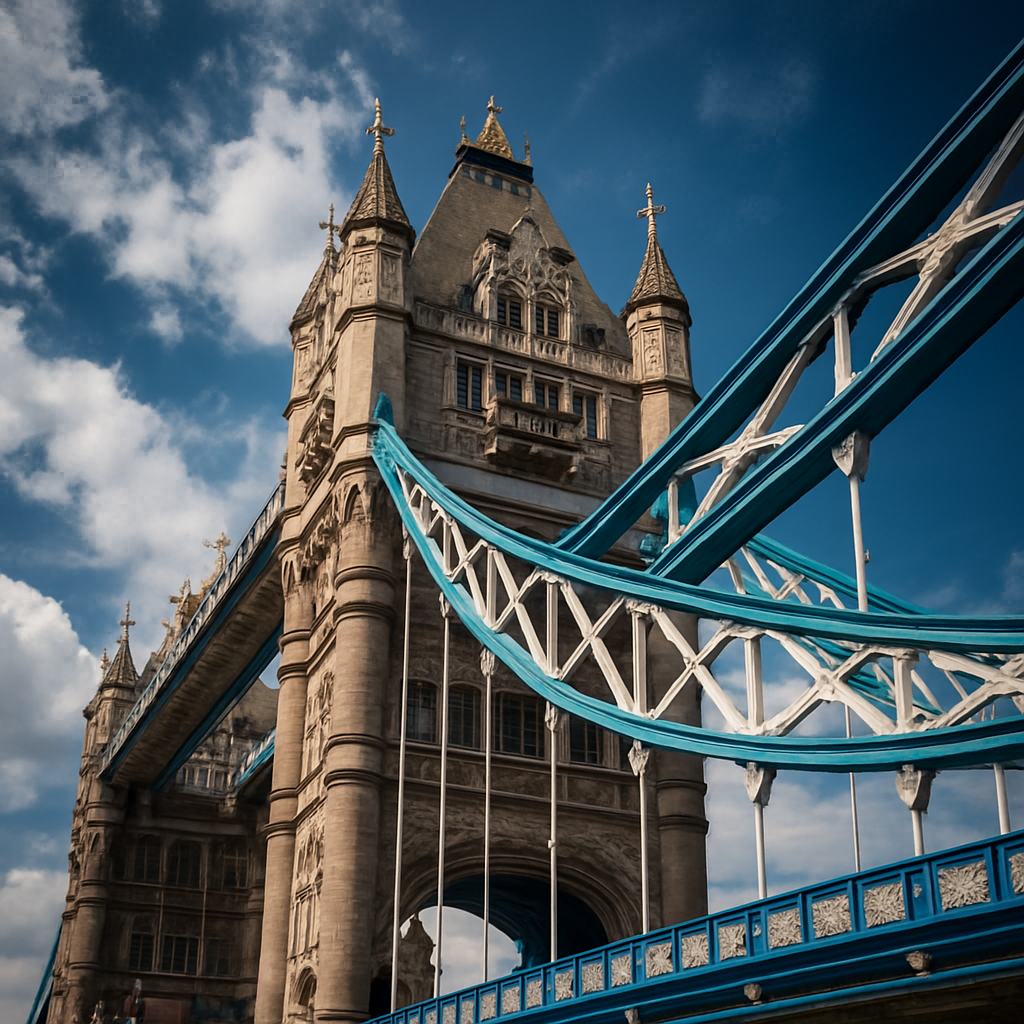
When Tower Bridge opened in June 1894, London could not agree on what it thought. Some hailed it as a marvel of the age; others sneered that the mock-Gothic towers were merely a stone costume thrown over a modern steel skeleton, a piece of Victorian fancy dress worn to keep the neighbouring Tower of London company. A century and more later the argument feels quaint — it is now impossible to picture the river, or the city, without it.
The problem the bridge was built to solve was a genuinely hard one. By the 1870s the crowded east end of London badly needed a river crossing, but the Pool of London was still a thundering working port, and tall-masted ships had to reach the wharves upstream. A conventional fixed bridge would have strangled the docks; a low one would have blocked the ships. After years of wrangling and more than fifty rejected designs, the City of London Corporation settled on a hybrid solution from the architect Sir Horace Jones and the engineer Sir John Wolfe Barry: a bascule bridge that could split down the middle and lift its two halves clear of the water.
“Bascule” comes from the French for see-saw, and that is essentially the mechanism — each half of the roadway is counterweighted so that vast leaves of steel can be swung upward with comparatively little force. The build took eight years, employed 432 construction workers, and consumed around 70,000 tons of concrete and over 11,000 tons of steel, the latter clad in Cornish granite and Portland stone both to armour the frame against the weather and to soften its modernity into something Londoners would accept.
Originally the leaves were raised by steam. Coal-fired boilers drove pumping engines that forced water into hydraulic accumulators, storing the energy that heaved thousands of tonnes of roadway skyward in barely a minute. That system worked faithfully until 1976, when the bridge was converted to oil and electricity. The bascules still rise around eight hundred times a year for passing vessels, each lift taking about five minutes from start to finish, and the schedule is published in advance — so with a little planning it is easy to time a walk to catch one.
The best of the story is hidden beneath the southern approach, in the Victorian engine rooms that now form part of the Tower Bridge Exhibition. The original steam machinery survives there, immaculately maintained: the great flywheels, the pumping engines, the coal-fed boilers and the massive accumulators, all gleaming and complete. It is one of the finest pieces of preserved industrial engineering in Britain, and one of the least crowded things to see in the whole area.
Above ground, the high-level walkways tell the human half of the tale. Built so pedestrians could still cross while the bridge was raised, they were quickly abandoned by a public that preferred to wait at road level, and for decades they gained a seedy reputation before closing altogether. Their twenty-first-century reinvention — complete with a glass floor set high above the traffic and the water — has given them, at last, the purpose their Victorian designers intended: somewhere to stop, and look, and take the measure of the river the bridge was built to serve.
Planning a London trip?
Browse our handpicked hotels around Tower Bridge — best price guaranteed, with free cancellation on most rooms.
Explore hotels